The future is hybrid: Aircoolung versus liquid cooling
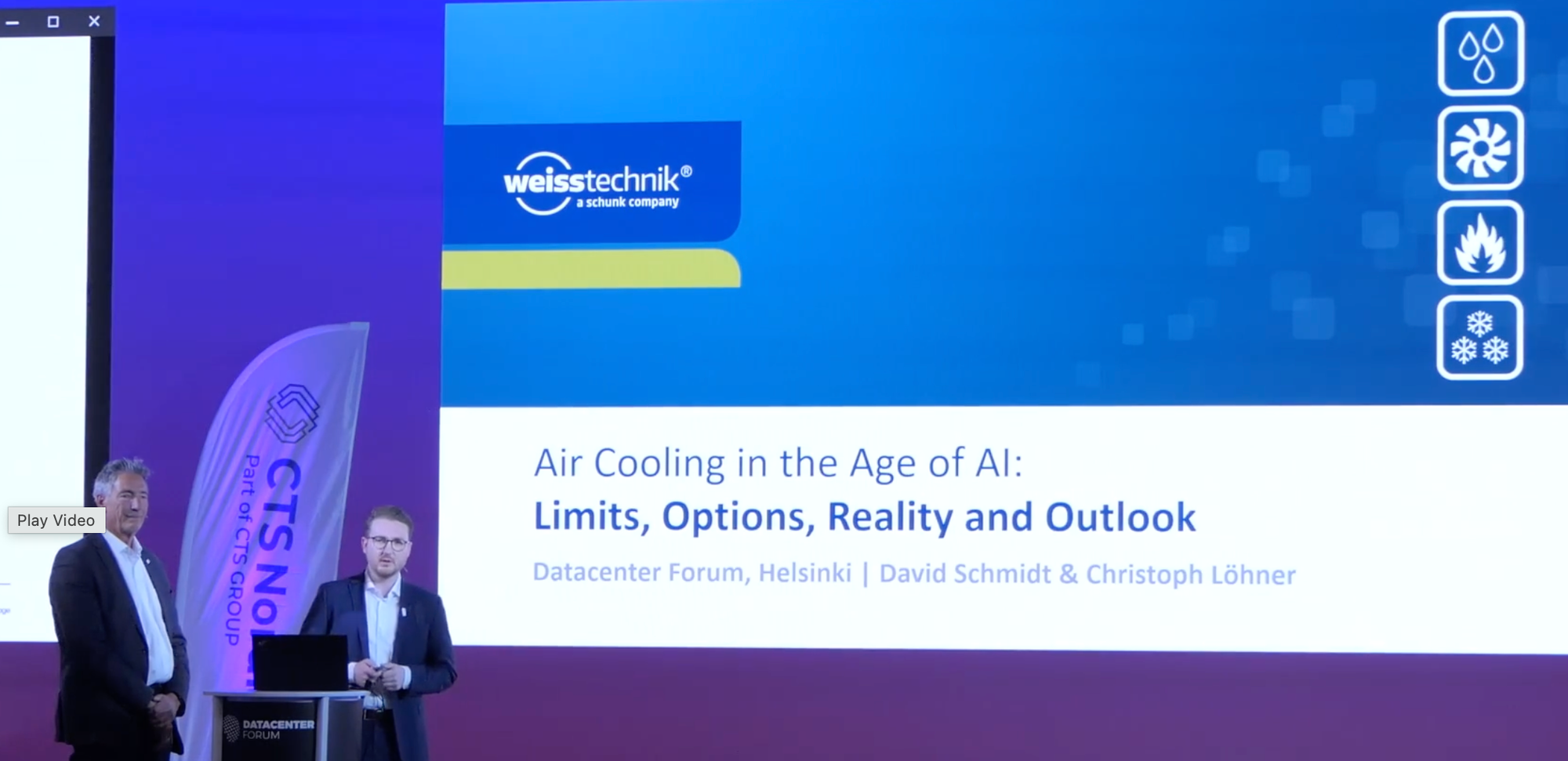
David and Christoph share insights on cooling of datacentres. Air Cooling in the Age of AI: Limits, Options, Reality and Outlook
TECHNICAL FEATURE
Air Cooling in the Age of AI: Limits, Options, and What Comes Next
The question used to be simple: how do you cool a data centre? For most of the industry's history, the answer was air. That is no longer the case — and AI is the reason why.
At a recent data centre industry event in Finland, engineers David Schmidt and Christoph Luna from Weisstechnik presented a detailed look at what AI-driven rack density is doing to cooling strategy. Their core message: air cooling is not dead, but its role has fundamentally changed.
The Density Problem
A few years ago, 40–50 kW per rack was considered high density. Today, 60 kW is common — and already insufficient for the next wave of AI infrastructure. NVIDIA's upcoming Rubin Ultra architecture is expected to reach 600 kW per rack. That number is not a future projection; it is an engineering reality that data centre designers have to plan around now.
The physical limit of air cooling alone sits at around 50–60 kW per rack. Beyond that threshold, a second system is required. AI has not just approached that limit — it has blown past it.
Liquid Cools the Hotspot. Air Stabilises the Room.
In a modern AI data centre, liquid cooling and air cooling are not competing systems — they are complementary ones.
GPUs generate concentrated, localised heat. Liquid cooling, via a cooling distribution unit (CDU) connected directly to the GPUs, removes that heat efficiently at the source. But the rest of the server infrastructure — CPUs and other electrical components — still depends on airflow. Switch off the air cooling in a hybrid environment and you lose room stability, pressure control and efficiency almost immediately, regardless of how well the liquid cooling is performing.
The conclusion is straightforward: liquid cools the hotspot, air stabilises the entire system. Hybrid environments require both.
The Options: A Practical Comparison
Four main air cooling approaches are in common use in hybrid environments. Schmidt and Luna compared them across footprint, flexibility, failure impact, service effort, energy efficiency and cost:
Active rear door heat exchangers are highly flexible and require no technical corridor — cooling is applied rack by rack. The trade-off is service complexity (valves and controllers multiply quickly at scale) and relatively lower energy efficiency due to small fan sizes.
CRA (computer room air) units are a familiar, off-the-shelf option with moderate cost and footprint. Flexibility is limited once installed, and energy efficiency is constrained by coil surface area and internal pressure drop.
Fan wall units deliver high cooling output but at the cost of a large footprint — stacked units approaching four metres in height require a technical corridor up to 3.1 metres deep. That depth has a direct cost: corridor space is not billable white space.
Cool wall units (Weisstechnik) operate as a split fan wall system, with fans mounted above the heat exchanger and the entire corridor functioning as a pressure chamber. This eliminates internal deflection losses, reduces required corridor depth to 1.5–1.7 metres and improves failure resilience — multiple fans can fail without losing stable airflow across the coil.
By the Numbers: Same Corridor, Three Outcomes
The presentation illustrated the practical difference with a real design scenario: a 25-metre technical corridor, supply air at 25°C, return at 36°C.
Same space, same physics — but a meaningful difference in cooling capacity and the amount of corridor consumed. The cool wall configuration delivers nearly double the output of CRA units and 25% more than stacked fan walls, while using the shallowest corridor of any of the systems compared.
Weisstechnik has deployed more than 150 MW of cool wall installations across Europe, including projects in Finland and the Baltics. A reference project for CTS in Norway has been running since 2023, handling 32 kW of pure air cooling in a constrained space using a customised cool wall configuration.
The Design Lesson
Schmidt made a point that will resonate with anyone who has worked through a retrofit: cooling decisions in AI environments cannot be treated as copy-and-paste exercises from previous projects. Building height, structural constraints, service access requirements and layout all feed into which system is appropriate. Cooling has become a building decision, not just an MEP decision.
The implication for operators and developers is clear: the earlier these decisions are made in the design process, the better. Redesigns and late-stage adjustments in high-density AI environments are expensive — and increasingly common.
Based on a presentation by David Schmidt and Christoph Luna, Weisstechnik, delivered at a data centre industry event in Finland.
Watch their full presentation here: https://bit.ly/4dG4Z3L