Kearney sees Finland and Norway among Europe's fastest-growing data centre markets
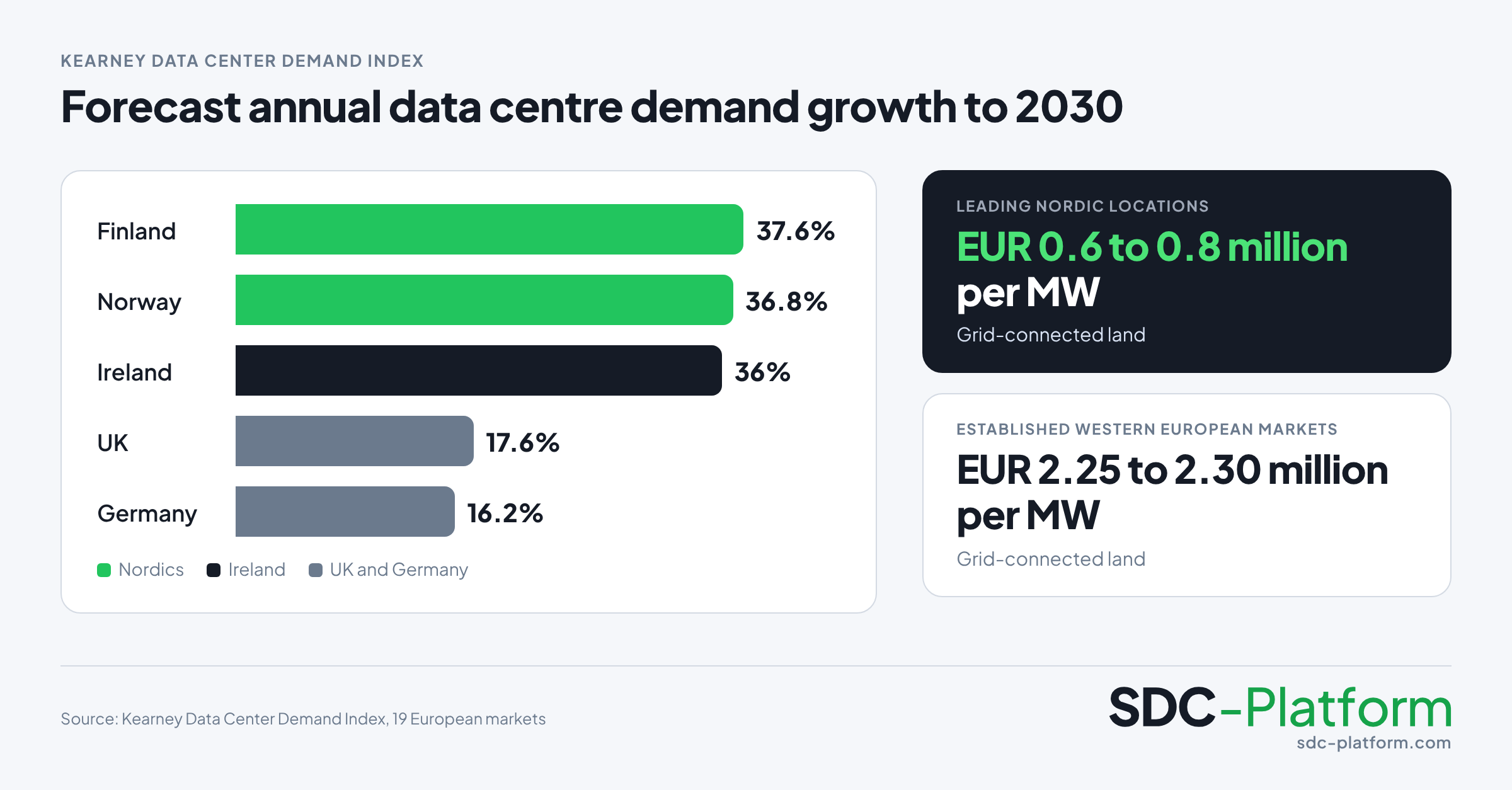
Kearney forecasts annual data centre demand growth to 2030 of 37.6% in Finland and 36.8% in Norway, against 17.6% in the UK. It puts grid-connected land in leading Nordic locations at EUR 0.6m to 0.8m per MW, against EUR 2.25m to 2.30m in Western Europe.

Finland and Norway are among the fastest-growing data centre markets in Europe, according to new research from consultancy Kearney reported by TechRadar and Data Centre Review. Kearney forecasts annual demand growth to 2030 of 37.6% for Finland and 36.8% for Norway, ahead of Ireland at 36%. The UK, currently Europe's second-largest market, is forecast at 17.6%, 18th of the 19 markets analysed, with only Germany lower at 16.2%. Data Centre Magazine reports that Hungary, Greece and Portugal score higher still.
The figures come from Kearney's Data Center Demand Index, a composite score built on indicators such as digital activity, cloud adoption, AI activity and market depth. It measures demand, not new capacity coming online. In an earlier article based on the index, Kearney put demand growth for 2025 to 2030 at 32.8% for the Nordic region, against 19.5% for the FLAP-D hubs of Frankfurt, London, Amsterdam, Paris and Dublin. In absolute terms growth stays concentrated: the UK, Germany and France account for 32.1% of the projected increase in index points.
Kearney links the gap to the cost of building rather than to weak demand. It estimates that land with an established grid connection costs about EUR 2.25 million to 2.30 million per MW in established Western European markets, against EUR 0.6m to 0.8m in leading Nordic locations. "Land with a grid connection costs three or four times what it does in the Nordics, so if a job can run in Finland or Sweden instead, it will," Kearney partner Owen Tracey told Data Centre Magazine.
Christoph Neunkirchen, Kearney's European Data Centre Lead, said power and land are now scarce enough that new capacity must match workloads that need to be close to users, customers and national jurisdictions. "Everything else will go where it is easier to build," he said.
Kearney sorts demand into four location types: metro-local, regional-portable, sovereign-local and power-led, where scalable, low-carbon and cost-competitive power is the main siting factor. For Nordic operators and developers, that points to the region competing mainly for portable and power-led workloads. Kearney's own siting framework still treats deliverable power as the first screen for any site, so grid access will decide how much of the forecast demand Nordic markets can capture.
For the UK, Kearney calls for lower electricity prices, cheaper land and faster grid connections.
Source: TechRadar, Data Centre Review, Data Centre Magazine, Kearney (via PR Times), Kearney: The new logic of data center siting
This article was written with AI assistance and reviewed by the SDC-Platform editorial team before publication.