Sweden´s AI strategy
Sweden´s AI strategy
INDUSTRY ANALYSIS • MAY 2026
Sweden’s AI Strategy: What It Means for Data Centres and Digital Infrastructure
Sweden has set a clear, government-backed course: become one of the world’s top ten AI nations. The country’s newly published AI Strategy — produced by the Government Offices of Sweden in 2026 — lays out the national framework for how Sweden plans to get there. For those working in data centres, compute infrastructure and digital services across the Nordics, the implications are significant and concrete.
A Strategy Built on Infrastructure Foundations
The Strategy is frank about what makes Sweden’s AI ambitions credible: access to fossil-free electricity, a favourable climate for compute infrastructure, secure and competitive digital connectivity, and a business sector already operating at the leading edge of AI adoption. These are not aspirational statements — they are the structural advantages Sweden is consciously building on.
The Government’s headline ambition in this space is unambiguous: Sweden should be a leader in Europe in climate-smart and competitive computing capacity, for both the private and public sectors. The emphasis on climate-smart capacity is not incidental. Energy use and environmental impact associated with AI are to be actively monitored and minimised, and the reuse of residual heat from data centres is specifically called out as something to be encouraged. For operators already integrating heat recovery into their facility design, Sweden’s policy direction is a tailwind, not a headwind.
AI Factories, Gigafactories and the Race for Compute
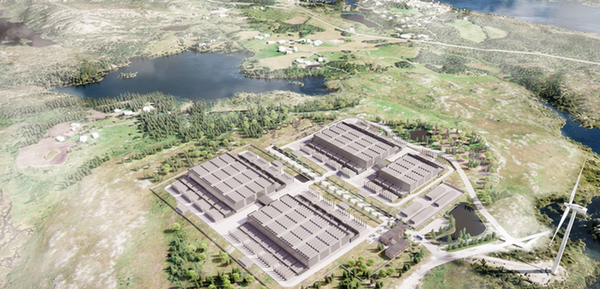
The document explicitly references Mimer in Linköping, currently being developed as one of the EU’s AI factories, providing researchers and companies with access to computing capacity and test environments. Beyond Mimer, the Government states its desire to see one of the EU-wide AI gigafactories established in Sweden — contingent on requirements around financing and energy use being met.
This is a deliberate positioning move. As the EU builds out its AI factory programme under the European High Performance Computing Joint Undertaking (EuroHPC) and the Digital Europe Programme, Sweden is working to ensure it captures a share of that infrastructure. For data centre investors and operators, this signals strong institutional appetite for large-scale compute investment, with government intent to align permitting, energy access and regulatory conditions to support it.
Global connectivity is also identified as a critical enabler — specifically, infrastructure that enables secure international connection, faster data transfer and low latency. This framing treats connectivity infrastructure as a prerequisite for the next generation of AI data centres and AI gigafactories, not an afterthought.
The Public Sector as a Demand Driver
One of the more operationally interesting elements of the Strategy is the Government’s plan to establish an AI workshop for the public sector, with foundations to be laid in 2026 and full operations targeted for 2030. The workshop will provide common, secure and robust AI infrastructure, functioning as a national competence centre for public administration across government agencies, regions and municipalities.
This is not a vague policy commitment. It directly implies demand for dedicated, secure compute infrastructure, data storage and processing capacity that meets strict public sector requirements around information security, cybersecurity and data protection. The Strategy explicitly notes that cloud services have become a major factor in AI development and use, and that public actors must have the conditions to access modern, efficient and secure cloud services — or alternative services that satisfy legal and security requirements.
For infrastructure providers, this creates a well-defined procurement horizon: a public sector customer base that needs AI-ready infrastructure, secure by design, and operational at scale within the next four years.
Energy, Expansion and Coordination
The Strategy directly addresses the tension between compute expansion and grid capacity. It states that the expansion of computing capacity needs to reflect access to the electricity grid and electricity production, and calls for improved coordination between relevant actors on facility location, as well as balance between energy production and consumption.
This is a practical signal that unconstrained data centre growth will not be the default. Grid access, energy planning and facility siting will require active coordination with national authorities. Operators planning new builds or expansions in Sweden should expect this coordination requirement to be formalised, and should engage early with energy and grid stakeholders.
Looking Further Out: Quantum and Space
The Strategy looks beyond current AI infrastructure cycles. It flags that commercialisation of quantum technologies may play a key role in several AI fields over the long term, requiring strong basic and applied research to unlock. It also highlights space technology as a strategic Swedish strength, with Esrange — the EU’s only mainland-based space centre — identified as a resource to be safeguarded and developed. AI-driven satellite data analysis is positioned as a near-future application area with implications for surveillance, climate action and infrastructure management.
The Bottom Line
Sweden’s AI Strategy is not a vision document — it is a structured policy framework with an accompanying action plan, annual review cycles and named responsible agencies. For the data centre and digital infrastructure sector, the key signals are: sustained government demand for secure, AI-ready compute capacity; active support for AI factory-scale infrastructure investment; a climate-smart framing that rewards efficient, heat-recovering facilities; and a grid-coordination requirement that will shape where and how new capacity gets built.
Sweden is positioning itself as the infrastructure backbone of Nordic AI leadership. The question for operators and investors is how quickly they align their own strategies with the direction the government has already committed to.
Source: Sweden’s AI Strategy, Government Offices of Sweden, 2026
https://www.government.se/contentassets/4e6b2d34f81048d688c35c831065395f/swedens-ai-strategy.pdf