Long-term power consumption development for data centers in Norway (Thema consulting for NDI)
Norway’s Data Center Power Consumption Set to Explode Tenfold by 2040, Driven by AI Surge
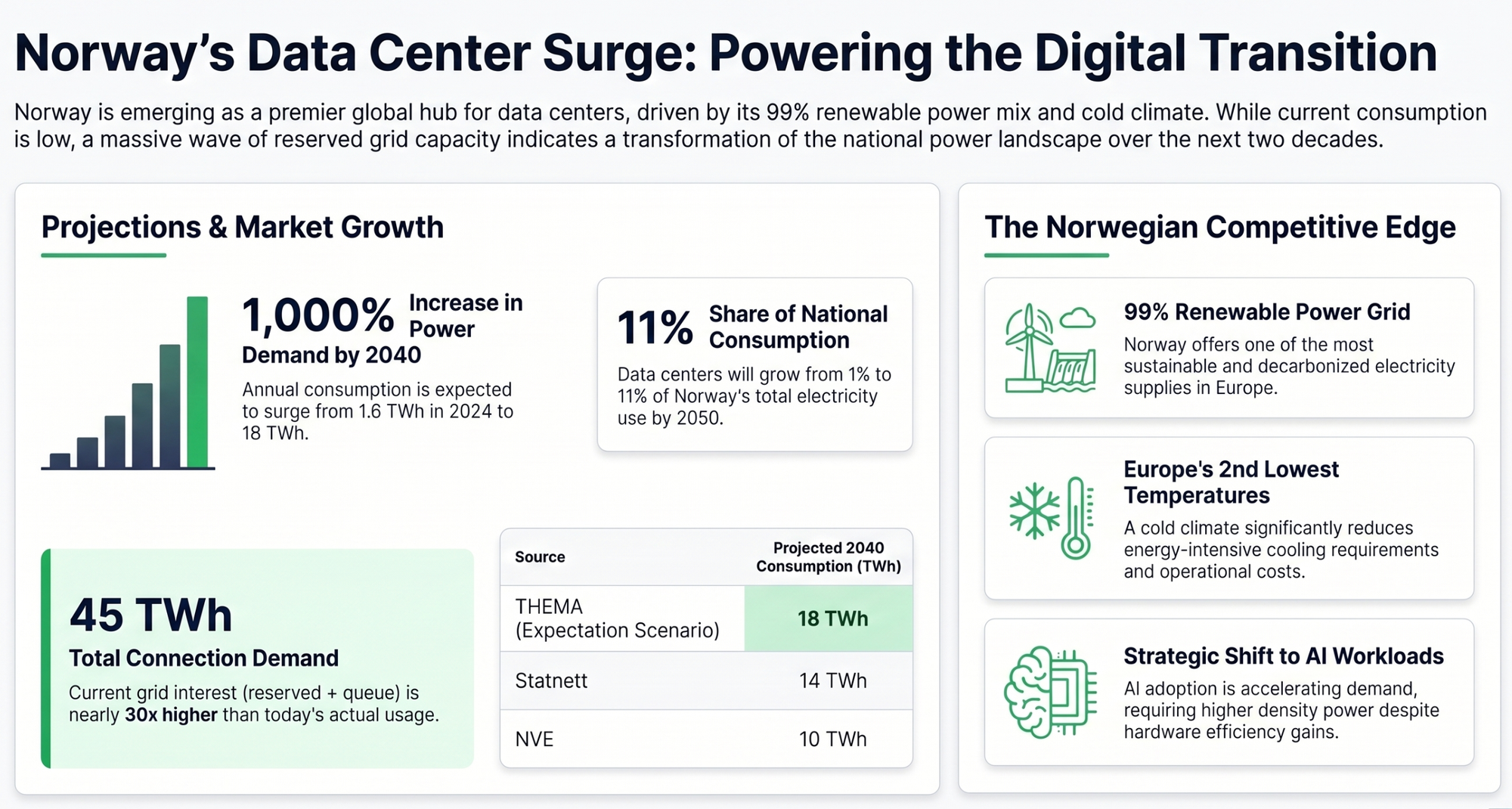
OSLO – A comprehensive new report released by THEMA Consulting Group reveals that Norway is on the verge of a massive expansion in its data center sector. The study, commissioned by the Norwegian Data Center Industry, projects that electricity demand from data centers will skyrocket from 1.6 TWh in 2024 to 18 TWh by 2040, a more than tenfold increase.
The AI CatalystThe primary engine behind this unprecedented growth is the global rise of Artificial Intelligence (AI), alongside cloud computing and blockchain technologies. Since the emergence of tools like ChatGPT, the adoption of AI has grown exponentially, requiring massive computational resources for both training complex models and the continuous "inference" needed to answer user queries.While traditional IT workloads (such as email and website hosting) currently make up the majority of data center activity, the report predicts a significant shift toward AI-driven infrastructure by 2030.
Norway as the "Ideal Spot"
The report identifies Norway as a highly competitive destination for these energy-intensive investments. Several key factors make the country attractive to global tech giants:
- Renewable Energy:
- Norway’s power system is 99% renewable, allowing companies to meet strict sustainability goals.
- Cool Climate:
- Norway has the second-lowest average temperature in Europe, which significantly reduces the energy needed for cooling server racks.
- Low Costs:
- Despite global fluctuations, Norway is expected to maintain relatively low and competitive electricity prices compared to the rest of Europe.
Grid Bottlenecks and Political Challenges
However, this rapid development is not without its hurdles. The report warns that growth is currently constrained by limited grid capacity and available power generation. Demand for grid connections has already surged to over 45 TWh, a figure that far exceeds current consumption and indicates a massive underlying interest that the current infrastructure cannot yet support.Beyond 2040, the report suggests that growth will depend on the political will to expand renewable generation, such as onshore wind and solar PV, to avoid a national power deficit that could drive up prices for other sectors.Beyond Passive ConsumptionThe analysis also highlights a potential "win-win" for the Norwegian energy system. Rather than being mere consumers, data centers can act as active participants in the power grid. By utilizing their battery backup systems and redundant infrastructure, they can offer flexibility services, shifting their load during peak demand or helping to stabilize the grid during winter when the system is most stressed.
Regional Outlook
Geographically, development has been concentrated in Southern Norway due to superior fiber connectivity and a more concentrated skilled workforce. However, as AI workloads become less sensitive to "latency" (the speed of data transfer), the report anticipates growing opportunities in Northern Norway, where land is abundant and power prices are often lower.In summary, while Norway is positioned to capture a large share of the European data center market, the pace of this "digital gold rush" will ultimately be determined by how quickly the nation can reinforce its power grid and scale its renewable energy production
Access the report here: https://static1.squarespace.com/static/6129463e215bea534c574c7f/t/68d15c8fa322771d27a02abf/1758551183178/Power+consumption+development+for+data+centers+in+Norway+-+report_updated+22.09.pdf