Finlands Data Center potential
MARKET REPORT • JUNE 2025
Finland's Data Centre Industry: Scale, Impact, and the Road to 1.5 GW
Finland is positioning itself as one of Europe's premier data centre destinations. A market study commissioned by the Finnish Data Center Association (FDCA) and the Confederation of Finnish Industries (EK), conducted by Ramboll and published in September 2025, quantifies that potential in detail — from gigawatts of planned capacity to billions in economic output and tens of thousands of jobs. For the infrastructure industry, the findings are striking.
Key Numbers at a Glance
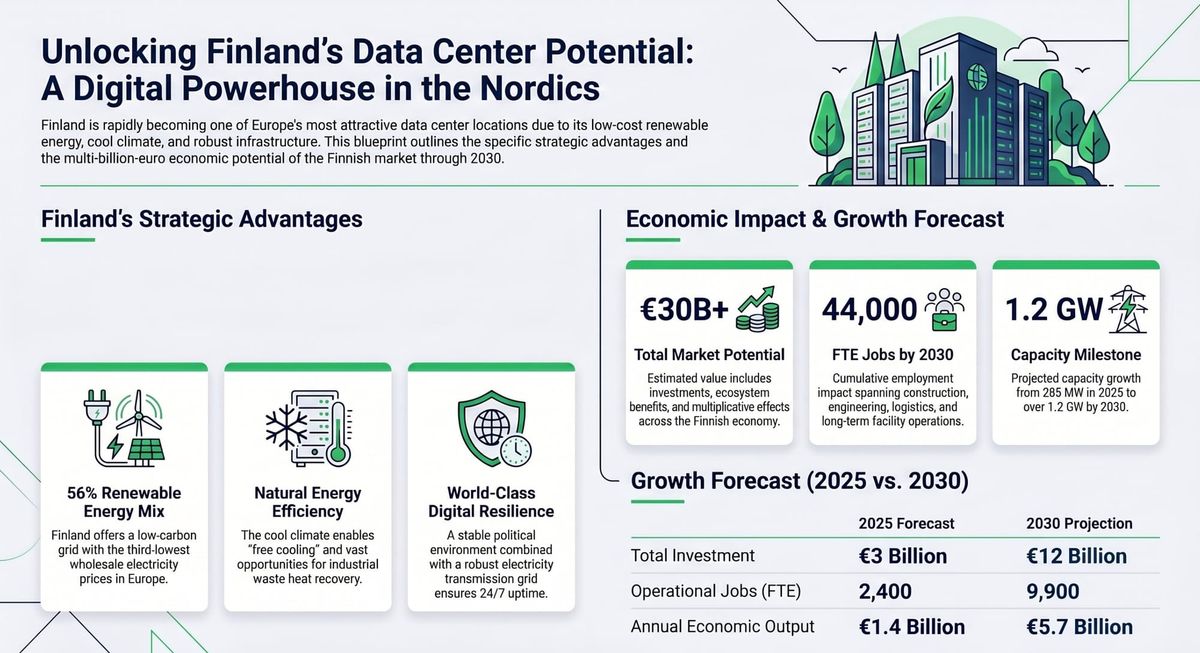
285 MW Total data centre capacity in Finland today (2025)
>1.5 GW Expected cumulative capacity by 2030 based on confirmed investment decisions
3.4 GW Total volume of publicly announced investment plans
>€30 bn Estimated total market potential including investments and ecosystem effects
€12 bn Total investments expected by 2030 based on finalized decisions
44,000 FTE Employment impact during construction phase (2025–2030)
9,900 FTE Annual employment impact once facilities are operational (2030)
€5.7 bn Annual economic output from operating data centres by 2030
€1.7 bn Tax revenues generated during the construction phase
+52% CAGR Annual capacity growth rate forecast to 2027
Capacity: From 285 MW Today to More Than 1.5 GW by 2030
Finland's data centre capacity currently stands at 285 MW — concentrated primarily in the Uusimaa region, and in particular the Helsinki metropolitan area. Confirmed investment decisions point to capacity reaching 1.5 GW by 2030, implying a compound annual growth rate of 52% to 2027, moderating to approximately 21% annually thereafter.
The pipeline goes considerably further. Total announced investment plans — including projects at varying stages of development — exceed 3.4 GW. Whether all of these materialise depends on individual project conditions, energy access, permitting timelines, and the broader investment climate. Cloud data centres account for the majority of total capacity despite being fewer in number than colocation facilities, reflecting the hyperscale scale of operators such as Google, whose facility in Hamina remains one of Finland's largest.
Geographically, the investment pipeline is broadening. While Uusimaa leads in the number of plans, future capacity is spreading to the Kouvola and Kajaani regions and beyond, as the growing size of facilities makes plot availability and grid access increasingly decisive factors. Former industrial sites — particularly old paper mills — are attracting strong interest due to existing transmission infrastructure, industrial zoning and available land.
Economic and Fiscal Impact: Multi-Billion Returns for the Finnish Economy
The economic case for Finland's data centre sector is built on two distinct phases. During construction, the impact is front-loaded and concentrated: cumulative multiplicative economic output from construction activity between 2025 and 2030 is projected at €8.6 billion, generating €1.7 billion in tax revenues across municipal, VAT, property, corporate and income taxes. Employment across the construction phase reaches 44,000 full-time equivalent roles.
Once facilities are operational, the impact becomes permanent and compounding. By 2030, operating data centres are expected to generate €5.7 billion in annual output and sustain 9,900 FTE roles, with annual tax revenues from operations reaching €400 million. The multiplier effect is significant: each data centre job generates additional work across energy supply, maintenance, IT services, security, logistics and local services. The study estimates that external partner workforce numbers match internal data centre headcount on a roughly equal basis.
Cloud data centres — driven by hyperscale operators — account for the largest share of economic impact in both phases. Colocation and private facilities contribute meaningfully, but the scale differential between cloud and other types is substantial. Google's Finnish subsidiary Tuike Finland Oy paid an average of €20 million per year in various taxes between 2018 and 2023, illustrating the long-term fiscal contribution even from a single operator.
The study puts Finland's total data centre market potential — encompassing investments, ecosystem benefits, and multiplicative effects — at more than €30 billion. This figure reflects both confirmed plans and the broader opportunity that expert assessments suggest remains well ahead of what publicly announced projects currently account for.
Finland's Structural Advantages: Energy, Climate, Infrastructure
Finland's appeal as a data centre location is grounded in a combination of structural factors that are difficult to replicate quickly elsewhere in Europe.
On energy, approximately 56% of Finland's electricity comes from renewable sources, and up to 95% is CO2-neutral. Finland holds the third-lowest average wholesale electricity price in Europe — a decisive operational cost advantage for energy-intensive facilities. Major data centre operators are reinforcing this profile by signing long-term power purchase agreements for renewable energy, directly financing new wind capacity and helping de-risk projects that might otherwise struggle to reach final investment decision.
The climate is a genuine operational asset. Finland's cool temperatures enable free cooling for much of the year, reducing PUE values and energy costs relative to warmer markets. Higher heating needs also create a meaningful opportunity for waste heat recovery: a handful of Finnish data centres are already supplying residual heat to district heating networks, and the EU Energy Efficiency Directive now requires new or significantly refurbished facilities above 1 MW to assess heat recovery potential.
Grid infrastructure is robust by European standards, and Finland has substantially more renewable energy capacity in the permitting pipeline than data centre demand would require — approximately ten times as many wind power projects (around 50 GW in permitting, equating to roughly 20 GW of baseload production) compared to announced data centre plans of 3.4 GW.
Market Uncertainties: Grid Constraints, Tax Risk, Labour Shortages
The study is candid about the risks that could temper the growth trajectory.
Grid access in Southern Finland is currently restricted. Fingrid has implemented temporary connection restrictions for new loads exceeding 10 MW in areas around Helsinki, Turku and Tampere, effective until 2027. This constraint is described as localised — Western, Northern and Eastern Finland have available capacity, and grid investment is underway in affected areas. For operators planning near-term build-outs in the Helsinki region, engagement with Fingrid on connection timelines is essential.
The most significant policy risk flagged in the study is electricity taxation. Debate over changing the tax classification of electricity for data centres has introduced uncertainty for investors. If Finland raises its electricity tax rate, the report warns that the country would lose its competitive edge as one of the most affordable electricity markets in the Nordics, potentially redirecting investment to competing countries. Political predictability — which Finland otherwise scores highly on, given its stable regulatory environment, low corruption and independent judiciary — could be undermined by this single variable.
Labour supply is a third constraint. Data centre investment is growing globally, and the resulting shortage of skilled engineers, designers and operations specialists is a shared challenge. The study notes that the volume of planned investments in Finland likely exceeds current qualified labour capacity, with the gap particularly acute for projects outside major urban centres where attracting and retaining talent is harder.
Environmental and Social Dimensions
Many of Finland's data centre operators have committed to net-zero targets, and the country's low-carbon electricity mix means facilities can in many cases run entirely on renewable power. PPA structures are directly incentivising new wind power capacity, with large tech operators providing the stable demand offtake that enables projects to reach financial close.
Data centres are formally recognised under the EU's CER Directive as critical infrastructure — essential to vital societal functions. Their operation supports data sovereignty when data can be stored and processed within Finnish and EU regulatory jurisdiction. Regional development benefits are material: construction-phase employment is particularly significant in rural and formerly industrialised areas, and the local value chain for maintenance, services and logistics creates sustained demand well beyond the data centre perimeter.
Community concerns around noise, landscape, land use and electricity pricing are noted as recurring issues. The study observes that concerns typically ease once construction begins and local employment becomes visible.
Who Is Investing: The Three-Way Market Structure
Of the 3.4 GW in announced investment plans, approximately 38% is driven by data centre operators (colocation providers), 37% by development and investment companies, and 25% by companies building for their own needs — hyperscale operators and major corporates.
Projects built for internal use progress fastest and with highest certainty, as they do not depend on securing third-party tenants. Of confirmed final investment decisions, around 65% follow this model. Operator-led and developer-led projects carry more execution risk, as realisation depends on securing end-users or buyers. Demand for colocation capacity is, however, rising as enterprise and public sector customers in Finland seek flexible infrastructure without direct ownership.
The Bottom Line
Finland's data centre market is large, well-evidenced and structurally supported. The combination of renewable energy, low electricity prices, a cold climate, strong grid infrastructure and a stable business environment creates conditions that few European markets can match at scale. The pipeline from 285 MW today to potentially 3.4 GW reflects genuine demand — driven by AI, cloud and sovereign data requirements — rather than speculative planning.
The principal risks are manageable but require attention: grid access in the south will ease by 2027, the electricity tax question needs political resolution, and the labour constraint will require proactive training and recruitment strategies. For operators and investors, the window to establish a leading position in Finland is open — but the regulatory and energy policy environment will determine how long that window stays that way.
Source: Ramboll / Finnish Data Center Association (FDCA) / Confederation of Finnish Industries (EK) — Potential of the Data Center Industry in Finland, September 2025.
https://www.fdca.fi/wp-content/uploads/2025/10/Potential-of-the-Data-Center-Industry-in-Finland.pdf